EMAIL: theteam@euramco.com      PHONE: +1 619. 670.9590

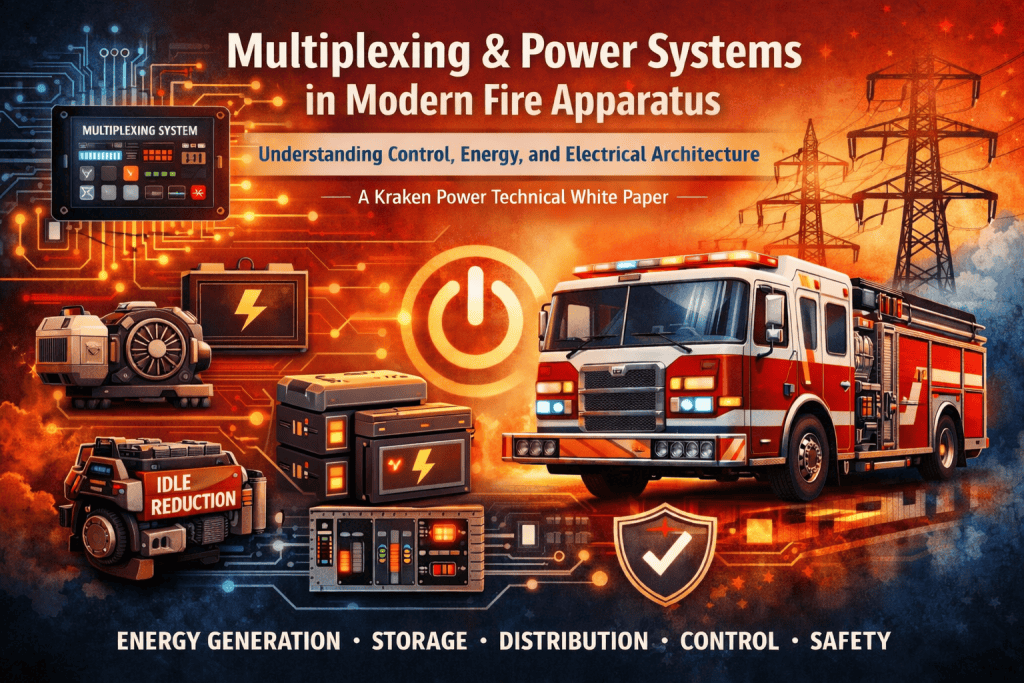
Multiplexing and Power Systems in Modern Fire Apparatus

Understanding Control, Energy, and Electrical Architecture

A Kraken Power Technical White Paper

Foreword & Glossary of Terms

Modern fire apparatus electrical systems are becoming increasingly complex. Terms such as multiplexingonboard poweridle reduction, and energy management are often used interchangeably in industry discussions, specifications, and marketing materials—despite referring to fundamentally different systems.

This white paper is intended to clarify these distinctions and provide an educational framework for understanding complete fire apparatus electrical system design, including energy generation, storage, distribution, control, and safety.

Glossary (NFPA 1900–aligned where applicable)

  • Low Voltage (LV):
    Electrical systems operating at nominal 12 VDC or 24 VDC, as defined in NFPA 1900, typically used for vehicle electronics, lighting, controls, and auxiliary equipment.
  • Line Voltage (AC):
    Alternating current electrical systems (commonly 120 VAC or 240 VAC) as defined in NFPA 1900, used for scene power, tools, lighting, and auxiliary loads via onboard inverters or generators.
  • Multiplexing:
    A distributed electrical control architecture using networked input/output (I/O) modules—typically CAN-based—to control vehicle subsystems and reduce wiring complexity.
  • Onboard Power System:
    A system responsible for electrical energy generation, recovery, storage, conditioning, protection, and distribution within the apparatus.
  • Starter Batteries:
    Batteries designed primarily to deliver very high current for engine starting (commonly lead-acid Group 31 batteries).
  • House Batteries (House Bank):
    Dedicated energy storage batteries designed for sustained electrical loads and cycling, separate from starter batteries.
  • Idle Reduction:
    Strategies that reduce engine runtime by automatically stopping and starting the engine based on electrical or operational demand.

Executive Summary

Fire apparatus multiplexing has become increasingly common over the past decade and is now standardized at many OEMs. At the same time, onboard electrical loads have grown significantly—often exceeding what traditional starter-battery-centric electrical architectures were designed to support.

This paper explains:

  • What multiplexing is and what it does well
  • What multiplexing does not do
  • Why power systems and control systems are separate engineering disciplines
  • How Kraken Power onboard power systems work alongside multiplexing
  • Why confusion exists today around multiplexing, power systems, and idle reduction
  • How modern apparatus electrical systems can be specified more holistically

The goal is not to replace existing architectures, but to clarify roles, reduce confusion, and support better long-term reliability and safety.


1. Evolution of Fire Apparatus Electrical Systems

1.1 Traditional Architectures

Historically, most fire apparatus in North America have relied on:

  • Large engine-driven alternators (often 400–600 A)
  • Large parallel starter battery banks (commonly 4–6 Group 31 lead-acid batteries)
  • Starter batteries supplying:
    • Engine cranking
    • Low-voltage electrical loads
    • Sometimes even line-voltage inverters

These designs were driven by reliability, simplicity, and available technology at the time.


1.2 Emergence of Multiplexing

Over the past 10–15 years, multiplexing systems have been adopted to address:

  • Wiring complexity
  • Increasing numbers of body and scene functions
  • Need for configurable control logic

Multiplexing represents a control innovation, not an energy innovation.


2. What Is Multiplexing?

Multiplexing is a distributed electrical control system.

What multiplexing does well:

  • Controls lighting, valves, and body functions
  • Manages interlocks and sequencing
  • Reduces copper wiring
  • Improves build consistency and diagnostics
  • Enables configurable operator interfaces

Multiplexing systems excel at controlling what turns on and off throughout the vehicle.


3. What Multiplexing Does Not Do

Multiplexing systems are often misunderstood as “the electrical system,” but they are not responsible for:

  • Electrical energy generation
  • Electrical energy storage
  • Charge acceptance or battery chemistry optimization
  • Long-duration energy endurance
  • Electrical system capacity definition

Multiplexing assumes that power is already available.


4. Alternators, Starter Batteries, and the Real Electrical Challenge

Fire apparatus alternators are often generously sized—commonly 400–600 A—primarily to:

  • Recover heavy starter battery discharge after 1000–1200+ A engine starts
  • Maintain voltage stability at idle
  • Overcome the high internal resistance of large lead-acid banks

This is appropriate and intentional.

However, without appropriate energy storage architecture, much of this alternator capability is underutilized or wasted.


5. Battery Chemistry and Charge Acceptance

Charge Acceptance vs State of Charge (SoC)

Lead-acid starter batteries:

  • Accept high current at low SoC
  • Rapidly reduce charge acceptance above ~70–80% SoC
  • Rarely reach true 100% SoC in service
  • Suffer from chronic partial-state-of-charge operation

Lithium Iron Phosphate (LFP) batteries:

  • Maintain high charge acceptance across most of their SoC range
  • Are well suited for sustained loads and cycling
  • Can efficiently absorb alternator output

6. Starter-Only vs House-Bank Electrical Architecture

Energy Flow Comparison

Starter-Only Architecture (Common Today)

  • Alternator feeds starter battery bank
  • Starter batteries feed all LV and often AC loads
  • Batteries experience:
    • Heavy cranking currents
    • Continuous parasitic loads
    • Incomplete recharge

Result: high stress, shortened battery life, unpredictable endurance.


Separated Starter + House Bank Architecture (Kraken Power Model)

  • Alternator output is actively managed
  • Starter batteries recover quickly after engine start
  • Excess alternator energy is stored in an LFP house bank
  • House bank supplies sustained LV and AC loads

Result: improved reliability, predictable electrical capacity, reduced maintenance.


7. Idle Reduction: A Feature, Not a System

Idle reduction strategies are often discussed as electrical solutions. However:

  • Idle reduction does not change battery chemistry
  • Does not improve charge acceptance
  • Can increase:
    • Engine start cycles
    • Starter battery stress
    • Emissions system wear

When combined with lead-acid-only architectures, idle reduction can exacerbate battery undercharging and premature failure.

Idle reduction should be evaluated only in the context of the complete electrical and energy storage architecture.


8. Kraken Power: The Electrical Grid of the Apparatus

Kraken Power onboard systems address a different discipline than multiplexing:

  • Energy recovery from existing alternator capacity
  • High-output LFP energy storage
  • Electrical protection and safety
  • NFPA 1900-aligned low-voltage and line-voltage distribution

Kraken Power does not replace multiplexing.
It feeds and supports it.


9. Electrical Distribution vs Electrical Control

DisciplinePurpose
Power SystemsGenerate, store, and distribute energy safely
MultiplexingControl and actuate loads throughout the vehicle

They interact—but they are not interchangeable.


10. Why Confusion Exists in the Market

  • Multiplexing is often described as “the electrical system”
  • Idle reduction is marketed as an energy solution
  • Specifications rarely separate:
    • Energy generation
    • Energy storage
    • Electrical distribution
    • Electrical control

This leads to incomplete or stressed system designs.


11. A Holistic Framework for Modern Fire Apparatus Electrical Design

A complete electrical system specification should independently address:

  1. Energy generation & recovery
  2. Energy storage (chemistry & capacity)
  3. Electrical distribution & protection
  4. Electrical control & actuation

Each is necessary. None replaces the others.


12. Conclusion

Multiplexing remains a valuable and necessary technology for modern fire apparatus. At the same time, onboard power systems address a fundamentally different challenge—how electrical energy is generated, stored, protected, and delivered.

Understanding the distinction enables:

  • Better specifications
  • Longer component life
  • Improved reliability
  • Safer, more predictable electrical performance

Kraken Power systems are designed to work alongside existing multiplex architectures, forming the electrical backbone that modern fire apparatus increasingly require.


© Kraken Power — Educational Technical White Paper

Search

Search